

A new type of coworker
Autonomous AI agents are a new concept that takes some getting used to. Knowledge work in companies is traditionally carried out by either code or by humans. Agents are a new type of worker — not quite code, not quite human, but somewhere in between.
- Faster than humans but slower than code
- More predictable than humans since it isn’t affected by sleep, personal conflicts, or mood swings—but less predictable than code.
- More intelligent than code since it can deal with uncertainty and fuzzy inputs—but less intelligent than a human for most tasks.
- Cheaper than humans for most tasks, but more expensive than code
Augment, not replace
The Abundly agent platform is designed to augment humans rather than replace them. Most professionals spend significant time on low-level routine tasks — work that takes time away from higher-value activities but can’t be automated with code because it involves fuzzy inputs, uncertainty, and judgment. An AI agent handles those tasks, freeing humans to focus on strategic work and make better use of their time.Benefits of AI agents
Compared to doing tasks 100% manually:- Lower cost — Despite token usage costs, total cost is often lower than manual work.
- Higher speed — Agents process information faster, don’t need sleep or breaks, and can do any number of tasks in parallel. You never need to wait to find time in the agent’s calendar—they are always available.
- Better control — Agents act based on written instructions, and will tend to do the same task the same way, with less variation than if the task was done manually.
- Higher quality — Agents are persistent and thorough. They read their given context and documents carefully and take every word into account, every time, while we humans sometimes get tired or distracted and take shortcuts.
Agents are not infallible. Like humans, they can make mistakes and need oversight. But with good instructions and context, they tend to make fewer mistakes than humans.
The four components of an agent
An Abundly agent consists four main components: LLM (Large Language Model) + Mission + Tools + Autonomy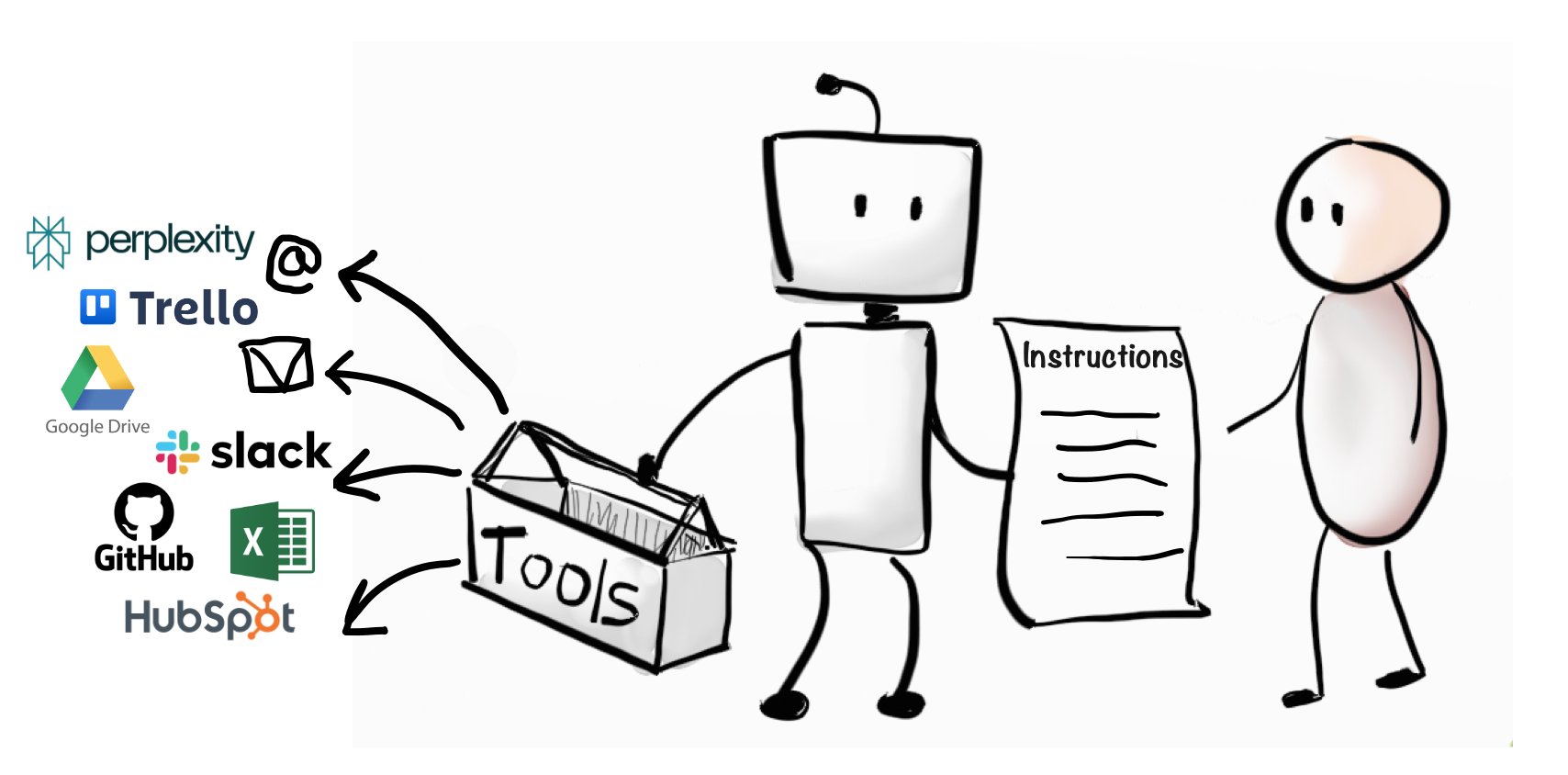
The four components that make up an Abundly agent
LLM (Large Language Model)
LLM (Large Language Model)
The external “brain” — a — that allows the agent to process information and make decisions.Abundly integrates with all major LLMs (Claude, GPT, Gemini) and provides a unified interface. By default we select the best model for agentic behavior, but advanced users can choose which model to use based on cost, speed, and capability tradeoffs.
Mission
Mission
The agent’s job description, or instructions, written in natural language. The instructions are used by the agent in all contexts — whether responding to a chat message, reacting to a trigger, or calling a tool.Instructions are versioned and can be updated over time by the user or by the agent itself. You choose the level of detail to provide, depending on how predictable vs creative the agent should be. Additional context can be provided via documents or links.
Tools
Tools
The tools the agent has access to. Tools are grouped into capabilities — for example, the Slack capability includes tools like posting messages, listing channels, and reading threads.You decide which capabilities the agent should have, and the agent will ask for additional capabilities if it needs them. Available capabilities include web search, web scraping, deep research, code execution, HTTP for interacting with any API, phone calling, SMS, and 40+ integrations like Slack, Gmail, Trello, Sharepoint, Notion, GitHub, and more.You can require human approval for sensitive actions (e.g., sending an email to an external domain) and set constraints like email address whitelists.
Autonomy
Autonomy
The ability to act independently, beyond just responding to chat messages:
- Schedule recurring tasks (“every Monday at 9am…”)
- React to triggers (incoming email, webhooks, calendar events, etc.)
- Proactively contact humans or other agents to share information or ask for input